You get three quotes for new floors. Two are close. One is noticeably lower. The difference often comes down to a line item you didn't know to ask about: subfloor leveling.
We see it every week in Monmouth and Ocean County. A homeowner chooses the lower number, the crew installs over the existing subfloor as-is, and six months later the LVP clicks when you walk on it, the tile grout cracks, or the hardwood develops gaps that weren't there on day one. The floor didn't fail — the substrate did.
What subfloor leveling actually is
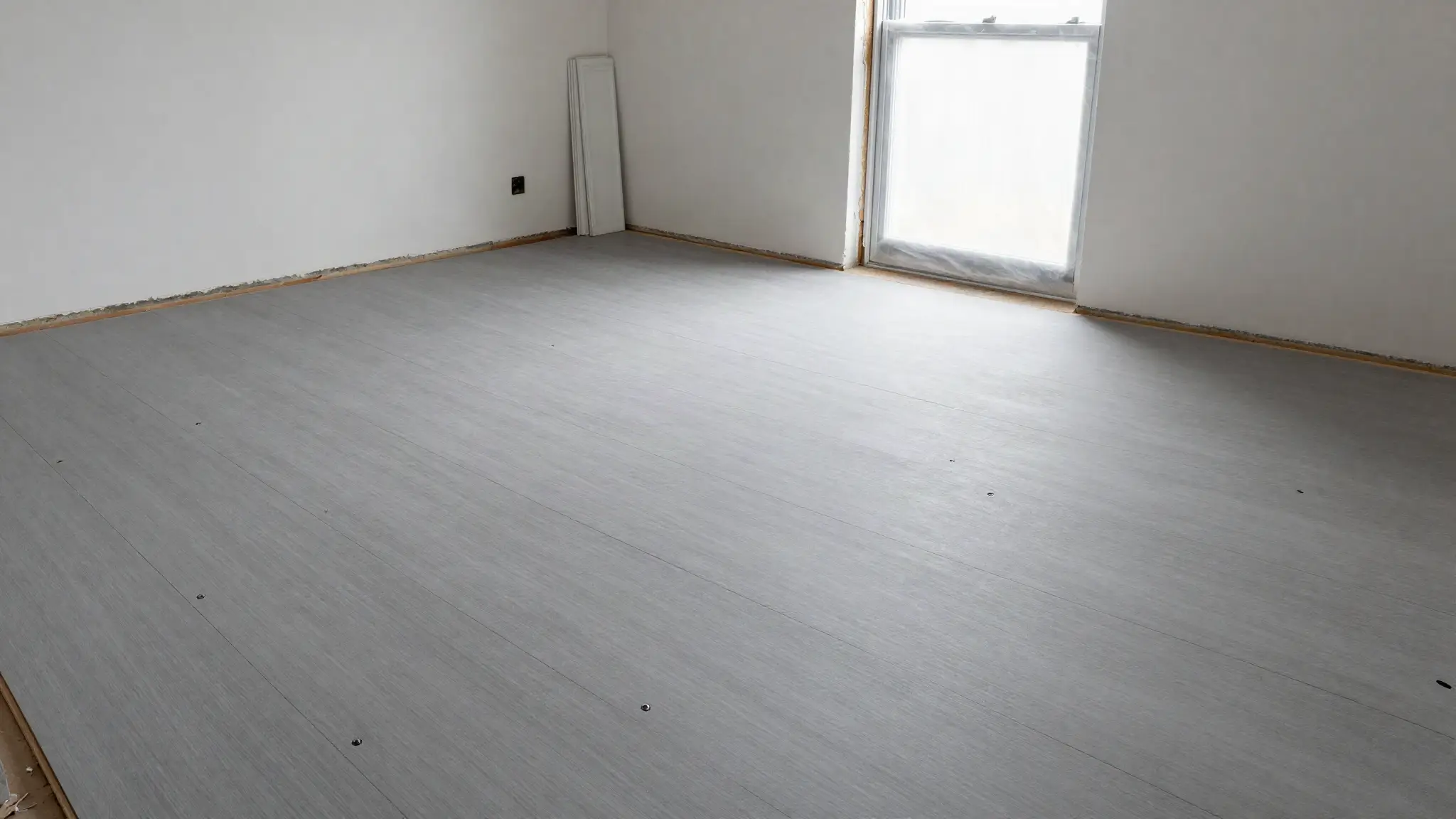
Leveling is not structural repair. It doesn't fix rotted joists, settle a foundation, or straighten a house that's tilted over fifty years. It addresses one thing: the flatness of the surface the new floor sits on.
The industry standard — shared by the National Wood Flooring Association (NWFA) and every major tile and LVP manufacturer — is a maximum deviation of 3/16 inch over 10 feet (or 1/8 inch over 6 feet). That is flat, not level. A floor can slope gently toward a drain and still be flat. What matters is that there are no dips, humps, or ridges that the finished floor has to bridge.
In practice, leveling means one of two things:
- Self-leveling underlayment (SLU): A cementitious pourable product that flows into low spots and creates a smooth, flat surface. Used for larger areas or when the variation is more than a few feathers.
- Patch and feather: Trowel-applied patching compound for isolated low spots, transitions, or minor corrections.
We also grind down high spots (common where old adhesive ridges remain, or where a partition wall was removed) and screw down loose subfloor panels before any leveling compound goes down. If the subfloor moves, the leveling layer cracks — and the new floor fails with it.
Why it shows up as a separate line item (and why that's honest)
A quote that folds leveling into a single per-square-foot price for "flooring installed" is either (a) assuming your subfloor is already perfect — rare in NJ homes older than 20 years — or (b) planning to skip it and hope you don't notice until the warranty window closes.
We list leveling separately because the scope varies wildly: a 12x12 bedroom might need a single bag of patch; a 600-square-foot open-concept first floor in a 1960s ranch might need a full SLU pour. Bundling it hides the real scope and makes comparison impossible.
What it costs in our market
In Monmouth and Ocean County, expect roughly:
- Patch/feather (isolated spots): $150–$400 per area, depending on depth and access.
- Self-leveling underlayment (full room): $1.50–$4.00 per square foot installed, including primer and labor.
- Grinding high spots: $200–$600 depending on square footage and hardness of the existing substrate.
These are additive to the flooring install price. A 500-square-foot LVP job at $6/sq ft installed ($3,000) might need $1,000 of leveling — making the real project $4,000. The quote that says "$3,500 all in" is not cheaper; it's incomplete.
The NJ context: why our homes almost always need some
The housing stock here tells the story. Postwar ranches and split-levels (1950s–1970s) in Middletown, Toms River, and Brick were built with plank subfloors over dimensional joists — and fifty years of humidity cycles have left them wavy. Shore-adjacent homes in Long Branch, Manasquan, and Point Pleasant often have crawlspaces with moisture-driven movement. Even newer construction in Holmdel, Marlboro, and Jackson can have slab curl or trowel ridges that exceed manufacturer tolerances.
We check flatness during every free in-home measurement with a 10-foot straightedge and a laser level. You see the numbers before you sign anything — no surprises on install day.
What happens when you skip it, by flooring type
| Flooring | What fails first | Typical timeline |
|---|---|---|
| LVP / rigid core | Hollow clicks, seam separation, locking system fatigue | 3–12 months |
| Glue-down LVT / VCT | Adhesive failure, telegraphing of trowel ridges | 6–18 months |
| Ceramic / porcelain tile | Lippage (uneven edges), cracked grout, cracked tile | Immediate to 6 months |
| Solid / engineered hardwood | Squeaks, seasonal gaps that don't close, board movement | First humidity cycle |
The manufacturer's warranty typically requires a flat substrate. If the installer didn't document the flatness check, the claim gets denied — and the homeowner is left with the bill.
The bottom line
Subfloor leveling is not an upsell. It is the difference between a floor that performs for decades and one that starts talking back within a year. If a quote doesn't mention it, ask: "Did you check the flatness? What did you find? Is leveling included or extra?"
We'll show you the straightedge reading on your own floor during the free in-home quote — and if leveling is needed, it will be a clear, separate line with a real number, not a mystery folded into the per-square-foot price.
Frequently Asked Questions
What is subfloor leveling?
Subfloor leveling fills low spots, grinds high spots, and creates a flat plane so the new flooring installs to spec. It is not the same as structural repair — it addresses surface flatness, not joist or foundation issues.
How do I know if my subfloor needs leveling?
We check with a 10-foot straightedge or laser level during the free in-home measurement. The industry standard (per NWFA and tile manufacturers) is no more than 3/16 inch variation over 10 feet, or 1/8 inch over 6 feet. Most older NJ homes have at least some areas outside that tolerance.
How much does subfloor leveling cost in NJ?
In Monmouth and Ocean County, self-leveling underlayment typically runs $1.50 to $4 per square foot installed, depending on depth and square footage. Small patches are priced per bag; whole-room pours are priced by the square foot. It is a separate line item on our quotes — never buried in a per-square-foot floor price.
Can I skip leveling to save money?
You can, but the flooring manufacturer's installation guidelines almost certainly require a flat substrate. LVP will telegraph every dip and click hollow; tile will have lippage and cracked grout; hardwood will squeak and develop gaps. The repair later costs far more than doing it right the first time.
Does leveling fix a sloped floor?
No. Leveling fixes flatness (local dips and humps), not slope (the whole room tilting). If your floor slopes because of foundation settlement or framing issues, that is a structural conversation — we will flag it and recommend the right specialist before any flooring goes down.
Sources & Further Reading
Not sure which floor is right for your home?
Get a free, honest in-home assessment — no pressure, no obligation.
Get My Free QuoteJust want a rough number to plan around? Request a ballpark estimate — about 60 seconds.
Serving Monmouth & Ocean County from our base in West Long Branch, including Brick, Jackson and Wall Township. See all 22 towns we serve.