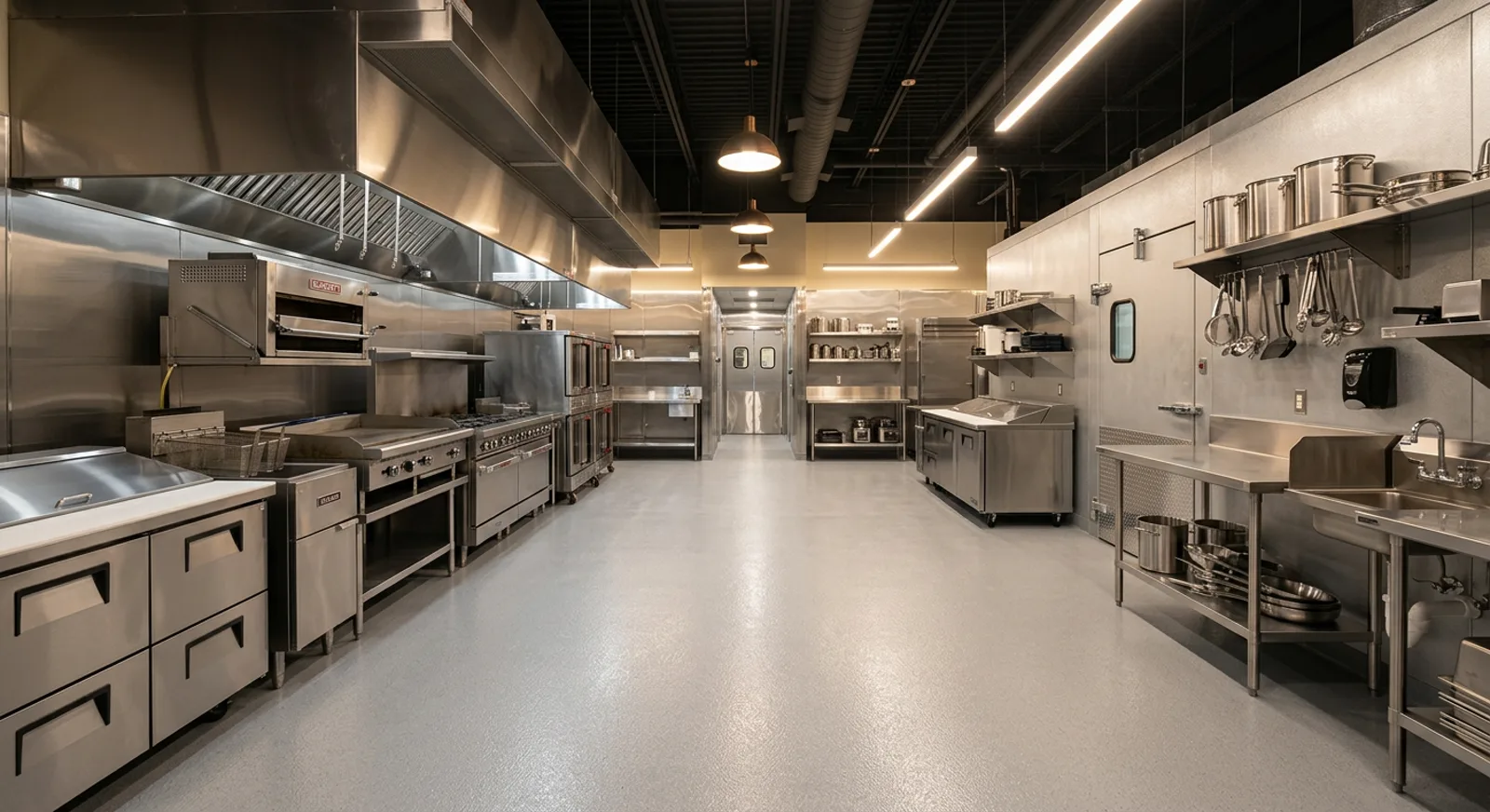
A restaurant kitchen floor has to pass a health inspection, survive grease and a hose-down, keep a cook on wet feet steady through a Friday rush, and be back in service before the next shift. Very few floors do all four, which is why the kitchen is the one room in the building where the flooring decision is mostly settled by law and physics rather than looks. Here is how the decision actually works in New Jersey.
What the state’s food code asks of the floor
New Jersey’s retail food establishments are regulated under N.J.A.C. 8:24, the state’s sanitation chapter for retail food, enforced by the state Department of Health and local health authorities. Its physical-facilities section (8:24-6.2) is the reason kitchen floors look the way they do: floors must be designed, constructed and installed so they are smooth and easily cleanable, and the code says antislip coverings or applications may be used for safety reasons — so traction does not cost you compliance.
Three provisions do most of the practical work. First, carpet and similar floor coverings are barred in food preparation areas, walk-in refrigerators, warewashing areas and anywhere else the floor sees moisture, flushing or spray cleaning. Second, where cleaning methods other than water flushing are used, the floor-wall juncture must be covered and closed to no larger than one thirty-second of an inch — that is why coved base is standard at the cook line. Third, where water-flush cleaning is used, floors must be provided with drains and graded to drain, with the junctures covered and sealed. If your kitchen floor slopes to a drain, that slope is a requirement, not a quirk.
Slip resistance: what the 0.42 number really means
The tile industry measures wet slip resistance as dynamic coefficient of friction (DCOF), tested with the DCOF AcuTest method in ANSI A137.1. That standard requires a minimum wet DCOF of 0.42 for level interior spaces expected to be walked on when wet. The Tile Council of North America’s own guidance is blunt about the limits: the measurement compares tile surfaces but does not predict whether a person will slip, and a tile above 0.42 is not automatically suitable for every project.
A kitchen makes that caution sharper, because the standard test uses slightly soapy water while a real kitchen floor sees grease, oil and food debris, which are far slicker. So treat 0.42 as the floor of the specification, not the target. For the cook line and dish pit we spec textured or unglazed quarry and porcelain tile well above the minimum, and we confirm the tested rating on the manufacturer’s data sheet rather than trusting a product line’s reputation. Maintenance matters too: TCNA notes that wear and surface contaminants change the COF of an installed tile over time, so a floor that tests fine when new can slide more a year in if it is not cleaned properly.
| Option | Where it fits | Watch out for |
|---|---|---|
| Slip-rated quarry or porcelain tile | Cook line, dish pit, bar wet zones, anywhere with a drain; meets cleanability rules directly | Hard on dropped glassware; grout needs sealing against commercial cleaning chemicals |
| Glue-down LVT | Dry back-of-house, offices, hallways, front-of-house, where look and low upkeep matter | Not the choice at wet prep and drain areas; needs a moisture-tested slab |
| VCT | Back-of-house dry storage on a budget | Strip-and-wax upkeep is a recurring labor cost; not for wet zones |
| Epoxy coating | Some kitchens and light industrial floors where a seamless coved surface is wanted | A separate specialty trade; if a space genuinely calls for one we say so rather than force a tile onto it |
Why the slab decides more than the tile does
Every glue-down floor inherits the condition of the concrete under it. Moisture vapor moving up through a slab can break the adhesive bond of LVT or VCT, and a slab that is out of flat telegraphs through thin materials. That is why every glue-down job we price starts with moisture testing and, where needed, self-leveling underlayment — the flooring and adhesive manufacturers specify the test method and the limit the slab must meet, and moisture damage outside those limits can fall outside the flooring warranty. We explain the testing in detail in our post on ASTM F2170 moisture testing, which covers how the numbers are taken and documented.
Tile is more forgiving of a hard life but less forgiving of an unprepared substrate in its own way: waterproofing membrane is standard in every wet area we tile, not an add-on, which is what keeps the slab under a dishwasher or a prep sink from becoming next year’s problem.
What it costs in our market
Numbers first, then the honest caveat that scope moves them. Glue-down LVT and VCT typically run around $4 to $8 per square foot installed in our market, and commercial tile runs $8 to $16 per square foot installed, per our commercial tile installation page. A restaurant kitchen almost always lands toward the higher end of its range, because slip-rated tile, waterproofing at the wet zones, slab prep and work scheduled around service hours all add real cost. Demolition of the old floor is usually its own line in the quote. For how the material choices compare across a whole commercial floor, see our LVT, VCT and epoxy comparison.
We install throughout Monmouth and Ocean County, and the business is registered as a New Jersey home improvement contractor (HIC 13VH12978400). For commercial bids, our commercial and trade page explains how we handle scope, insurance and scheduling on that side, and our restaurant and bar flooring page covers the front-of-house half of the building.
Getting it done without losing a service
The last worry for most operators is not the floor, it is the calendar. Restaurant work is routinely scheduled overnight, in the early morning before prep starts, or one section at a time, and that scheduling is priced into the bid up front rather than appearing as a change order once the crew is on site. If you have an inspection or permit renewal date, tell us at the walk-through and the affected area can be done and dry well ahead of it.
The bottom line: in a New Jersey commercial kitchen, the code sets the baseline — smooth, easily cleanable, no carpet, drainage where flushing happens — and slip-rated tile at the wet zones is the surface that meets it while holding up to grease. The slab underneath decides whether whatever you install lasts. Bring us the square footage, the drain locations and your service hours, and the bid will tell you exactly what your kitchen needs.
Frequently Asked Questions
What does New Jersey law require for a restaurant kitchen floor?
New Jersey’s retail food code, N.J.A.C. 8:24-6.2, requires floors to be smooth and easily cleanable, and says antislip coverings or applications may be used for safety. Carpet and similar floor coverings are barred in food prep, warewashing and other wet areas. Where water-flush cleaning is used, floors must drain and the floor-wall junctures must be covered and sealed.
What slip rating does a commercial kitchen floor need?
ANSI A137.1 sets a minimum wet DCOF of 0.42 for level interior spaces expected to be walked on when wet, and TCNA is explicit that the number is a starting point, not a guarantee. Grease is slicker than plain water, so for a cook line or dish pit we spec textured, slip-rated tile well above the minimum and confirm the rating on the product’s data sheet.
How much does commercial kitchen flooring cost in NJ?
In our market, glue-down LVT and VCT typically run around $4 to $8 per square foot installed, and commercial tile around $8 to $16, per our commercial tile page. A kitchen usually needs the higher end, because slip-rated tile, waterproofing at wet zones and slab prep all add cost. Send your scope for a written bid.
Can you replace a kitchen floor without closing the restaurant?
Usually, by working the hours the kitchen is dark. We schedule restaurant work overnight, early morning before prep, or one section at a time, and it is priced into the bid up front rather than added as a change order. Tell us any inspection or permit deadline at the walk-through and we schedule so the area is done and dry well ahead of it.
Can LVT be used in a commercial kitchen?
Not everywhere in one. Glue-down LVT performs well in back-of-house dry zones, offices and hallways, but along the cook line, dishwasher and any floor with a drain, the code’s cleanability rules and grease exposure point to slip-rated quarry or porcelain tile instead. Most restaurants end up with tile in the wet zones and LVT elsewhere.
Sources & Further Reading
- New Jersey Department of Health, N.J.A.C. 8:24 — Sanitation in Retail Food Establishments (Chapter 24)
- Tile Council of North America, Coefficient of Friction — new method and requirements (DCOF AcuTest, ANSI A137.1)
- FDA Food Code 2022, chapters 6-101.11 and 6-201.11 (model code behind state retail food rules)