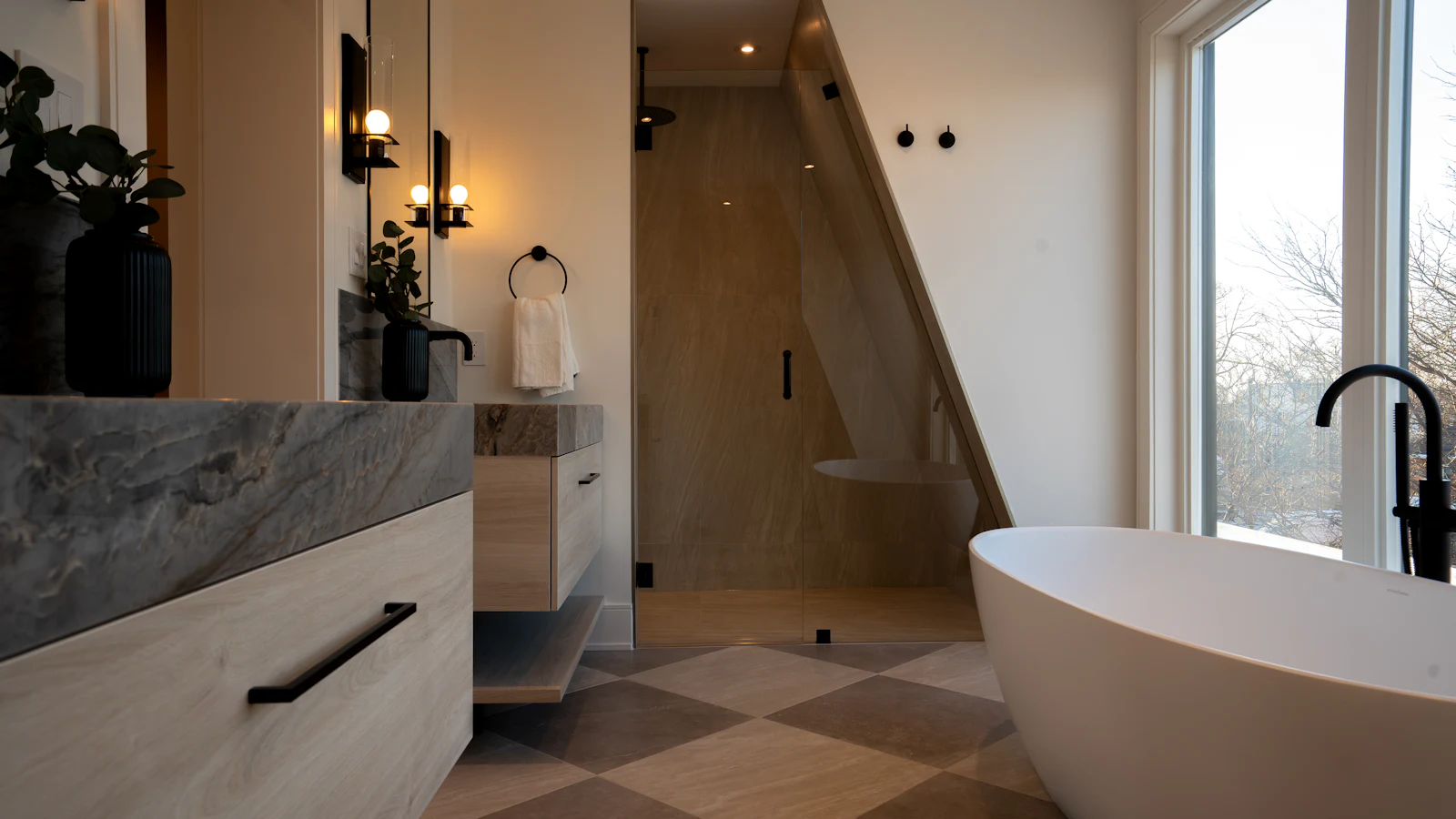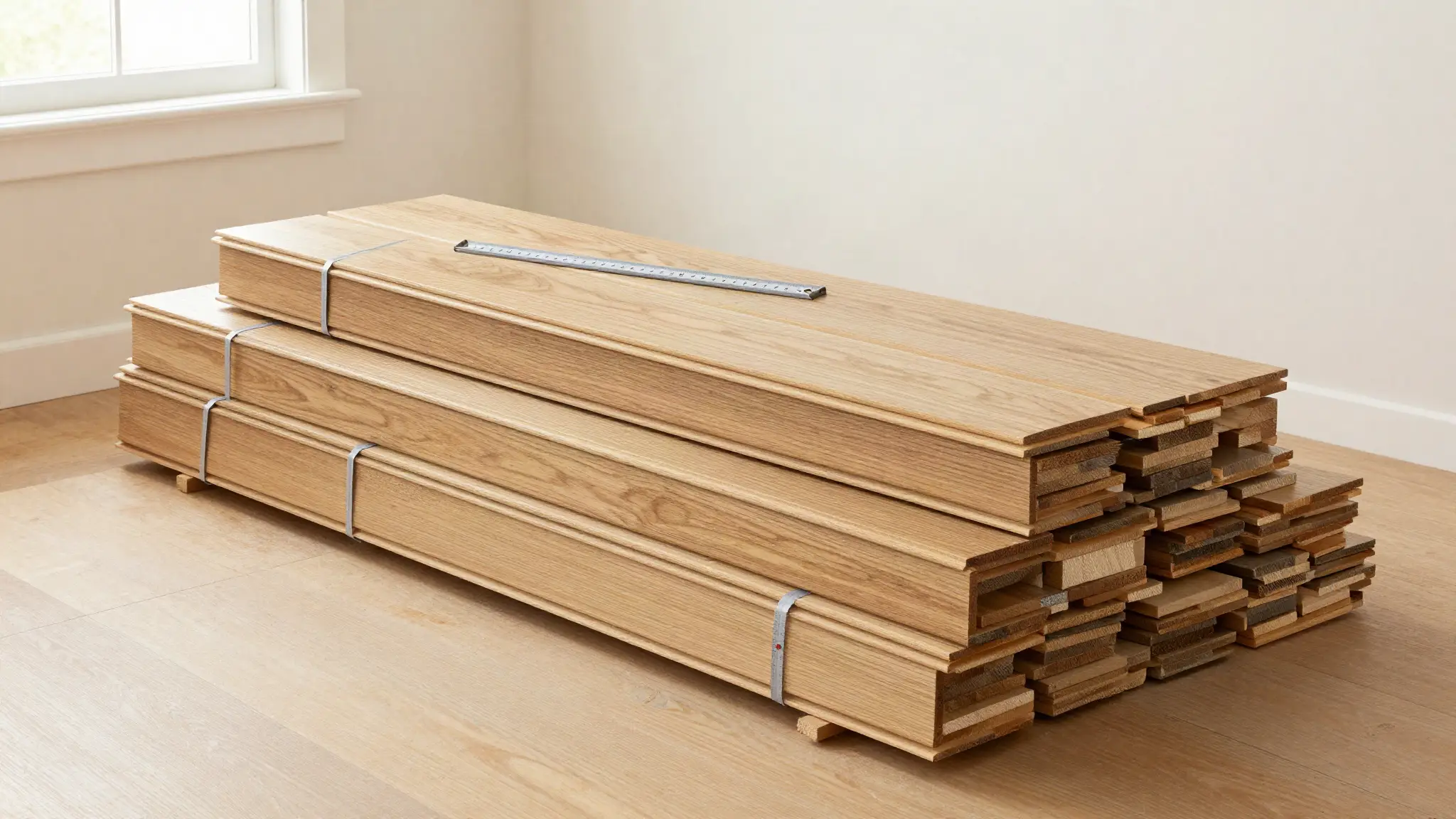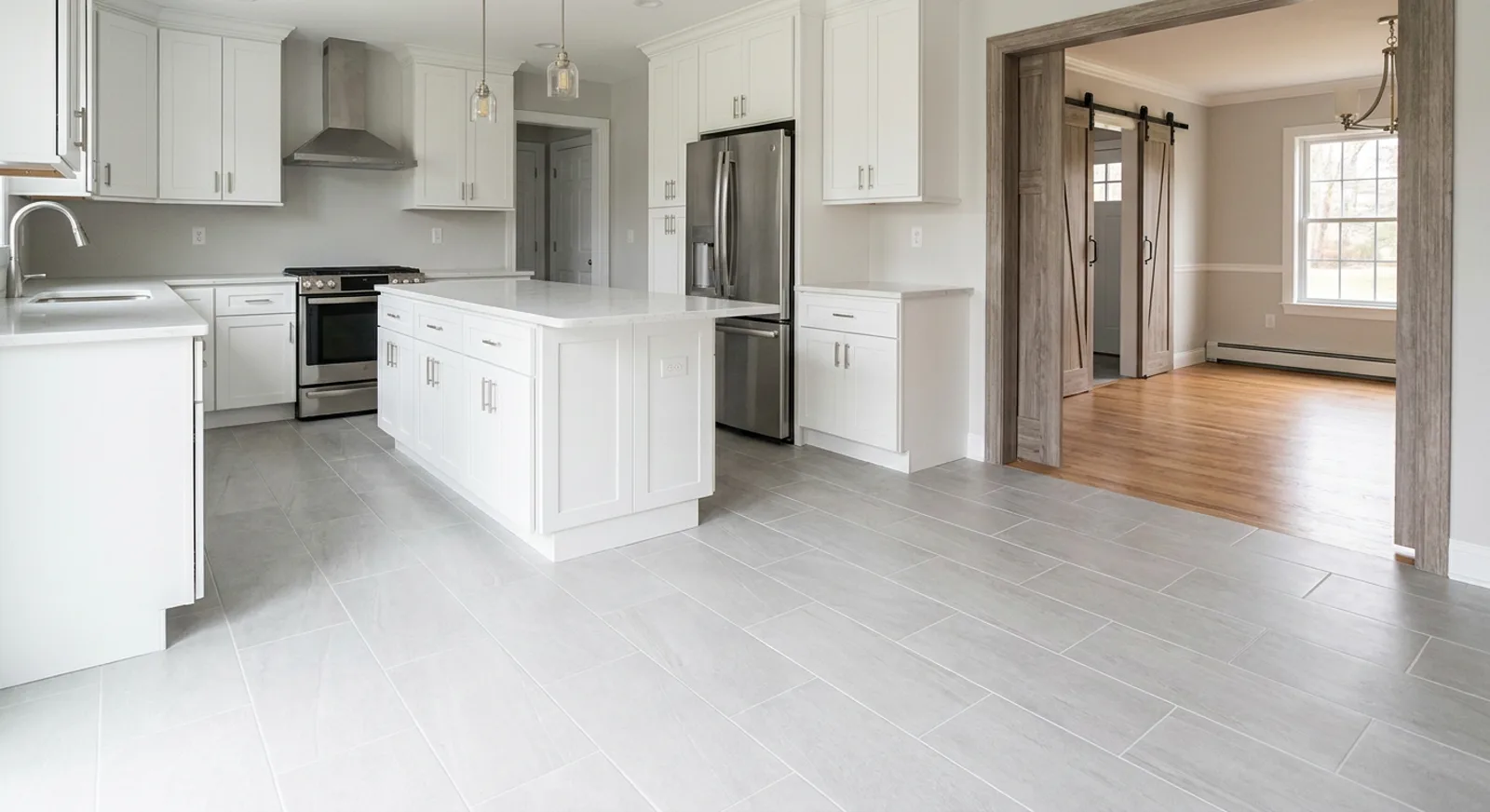
Most kitchens in Monmouth and Ocean County end up with one of three floors: porcelain tile, luxury vinyl plank (LVP), or hardwood. All three work — but they work differently, and the right pick depends on your water risk, your budget, and how long you plan to stay in the house. Here is how we walk homeowners through the decision.
**Quick answer:** tile is the most durable and water-proof choice; LVP is the best value and the most forgiving; hardwood is the most beautiful and the most demanding. None of them is a bad answer, but one of them is usually the best answer for your specific kitchen.
Why kitchens are their own flooring problem
A kitchen floor takes more abuse than any other room in the house: dropped pots, chair legs, drips at the sink and dishwasher, and sand or grit tracked in from the driveway. Around the Shore, there is an extra factor — humidity swings from late spring through early fall, the same seasonal moisture we cover in our guide to flooring for Jersey Shore humidity. Whatever you install has to handle all of that at once.
That is why we rarely recommend the "kitchen floor special" you see at a big-box store: a thin laminate or vinyl sheet that looks good on day one and fails at the seams by year three. Water is the enemy, and kitchens are where water lives.
Choose porcelain tile if durability comes first
Porcelain tile is the closest thing to a lifetime kitchen floor. It is impervious to water, drops and dents, and it never needs refinishing — mopping is the whole maintenance story. The tradeoffs are honest ones: it is the most expensive of the three to install (in our market roughly $8 to $18 per square foot installed, as covered in our tile cost guide), it is hard underfoot, and it is cold in winter unless you add radiant heat. Grout also needs sealing every few years to stay stain-free.
For a kitchen with a water-prone layout — a sink on an exterior wall, a dishwasher you actually use every day, a dog bowl that never stays where you put it — tile is what we install when the owner says "I never want to think about this floor again."
Choose LVP for the best value and the most comfortable floor
Luxury vinyl plank has quietly become our most common kitchen installation, and the reason is simple: it is waterproof at the plank level, warmer underfoot than tile, quieter, and considerably cheaper. Installed LVP in our market runs roughly $4 to $9 per square foot — about half what tile costs for the same room, as broken down in our LVP cost guide.
The honest downside is lifespan. A quality LVP with a thick wear layer will last many years in a kitchen, but it is not immortal — a dropped knife can gouge it, and heavy appliances can dent it in ways tile shrugs off. It also does nothing for resale the way real hardwood or stone-look porcelain does. It is the right choice when you want the best balance of price, comfort and water protection, especially if you may want to change floors again in a decade.
Choose hardwood for beauty — if you accept the tradeoff
A hardwood kitchen floor is a classic, and in older Monmouth County homes it is already there under the vinyl. It looks better than either alternative and it can be sanded and refinished instead of replaced. But we will be straight with you: wood and water are not friends. Standing water at a sink or dishwasher will eventually stain or cup the boards, which is why our guide to water-damaged hardwood floors exists. It is also the most maintenance of the three.
If your kitchen already has hardwood in good shape, we almost always say keep it and protect it — refinish it rather than cover it (see our signs your floors need refinishing). If you are choosing from scratch, go in knowing the risk. Installed hardwood in our market runs roughly $6 to $14 per square foot, per our hardwood cost guide.
The side-by-side comparison
| Material | Installed cost (NJ) | Water protection | Comfort | Best for |
|---|---|---|---|---|
| Porcelain tile | $8–$18 / sq ft | Best | Hard, cold | Water-prone kitchens, long-term owners |
| Luxury vinyl plank | $4–$9 / sq ft | Waterproof at plank level | Warm, quiet | Best value; families; may resell in 5–10 years |
| Hardwood | $6–$14 / sq ft | Needs protection | Warm, classic | Already there; homes where resale appeal matters |
Our bottom line for NJ kitchens
If the kitchen already has hardwood worth saving, refinish it — that is often the cheapest beautiful answer. If you are picking fresh and want the lowest lifetime cost, LVP wins. If you want the floor you never think about again, porcelain tile wins. The one that is usually wrong for a Shore-area kitchen is the cheapest product on the shelf, because water finds thin material fast.
The free in-home quote is how most of our Monmouth and Ocean County customers start: we look at your actual subfloor and layout, and tell you which of the three really makes sense for your kitchen — no obligation.
Frequently Asked Questions
What is the best kitchen flooring for NJ homes?
For most NJ kitchens, porcelain tile or luxury vinyl plank is the best choice. Tile is the most water-proof and durable; LVP is waterproof, warmer underfoot and costs roughly $4–$9 per square foot installed versus $8–$18 for tile. Hardwood works but needs protection from sink and dishwasher water.
Is LVP waterproof enough for a kitchen?
Yes — quality LVP is waterproof at the plank level, which makes it a good kitchen floor even at the sink and dishwasher. The weak points are the seams between planks and the install quality, which is why a flat, prepared subfloor matters.
Can hardwood work in a kitchen?
It can, and in older Monmouth County homes it often already exists. The tradeoff is water: standing spills at a sink or dishwasher can stain or cup the boards over time. Many owners keep existing kitchen hardwood and refinish it instead of replacing it.
How much does it cost to re-floor a 150 sq ft kitchen in NJ?
Roughly $1,200 to $2,700 for tile (at $8–$18 per square foot) and roughly $600 to $1,350 for LVP (at $4–$9), before demolition and any subfloor repairs. Those ranges come from our published NJ cost guides for each material.