Recoat vs. sand-and-refinish: which job your court needs
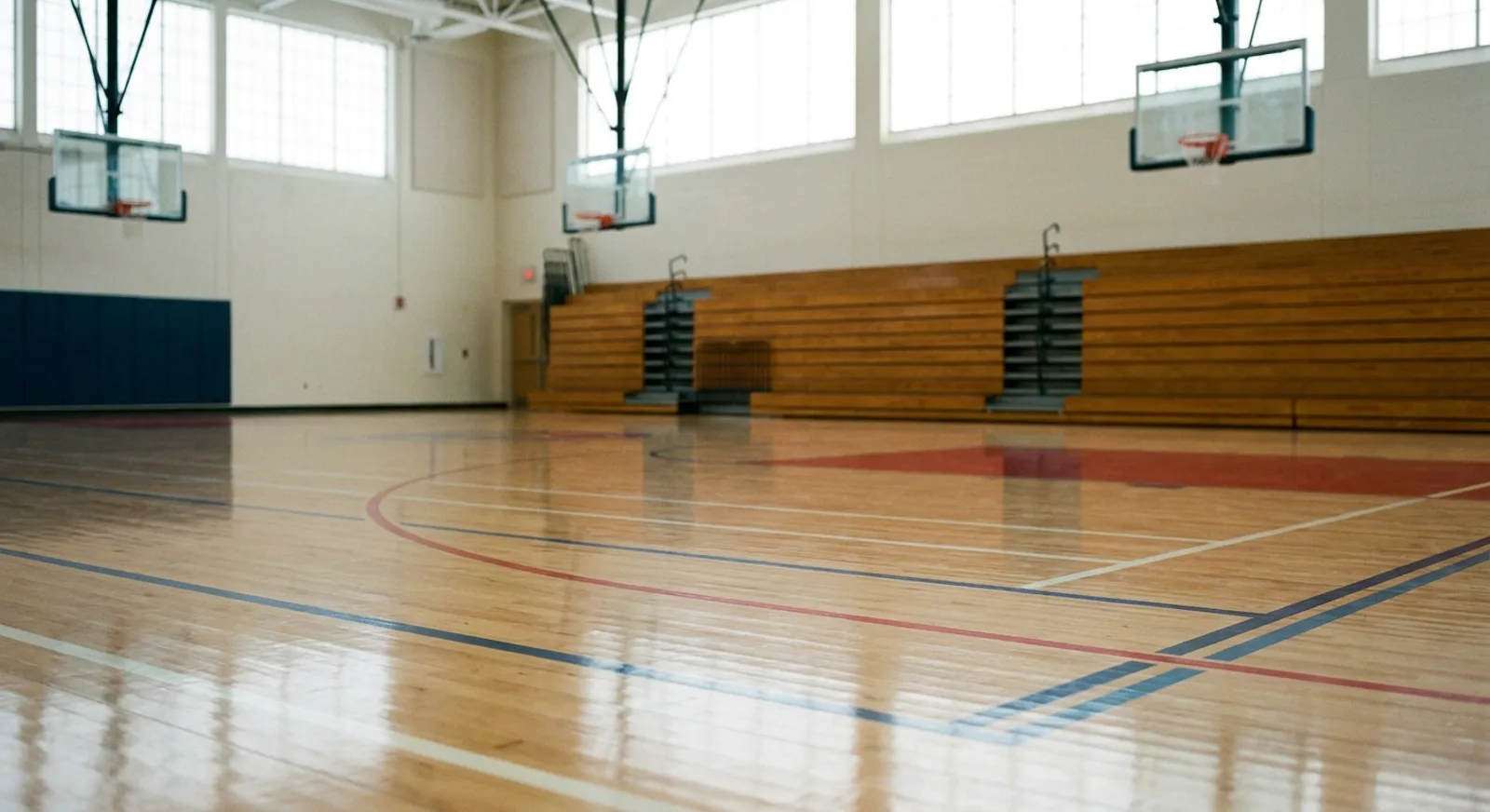
A screen and recoat is annual maintenance. The crew machines the top layer of the existing finish with a fine abrasive screen, cleans the surface thoroughly, and applies one or two fresh finish coats on top of the finish that's already there. It does not touch the wood. It removes none of the finish history, so it only works while the existing finish is intact — just dull from a year of shoes and dust. A full sand-and-refinish is a restart. The crew sands down through every finish layer to bare maple, repairs damaged and dead boards, seals the raw wood, repaints the game lines and any logos, and applies fresh finish coats. It is the fix for floors whose finish has worn through, that carry stains or old water damage, or that are past the point where another coat on top will bond. Knowing which category your court falls into decides nearly the whole price.
What it costs at a typical New Jersey school
On the standard high-school court of roughly 8,000 to 10,000 square feet, a screen and recoat typically runs about $3,500 to $15,000, and a full sand-and-refinish about $35,000 to $70,000. Those are final project numbers for the court itself, using typical statewide rates — roughly $0.50 to $1.50 per square foot for a screen and recoat and $3 to $7 per square foot for a full sand. Bigger multipurpose facilities run higher because there is simply more court. Game-line and logo painting is almost always its own line item.
Where the money to material goes
Sports-facility finish, sealer and line paint are quoted separately from labor in an honest bid. High-build athletic urethanes, penetrating sealers and the paint used for game lines and center-circle logos add up to a real line on the invoice, and oil-modified versus water-based finishes carry different costs and different recoating schedules. Contractors who bury material inside one lump price make it harder for you to compare bids. Ask any bidder to itemize labor versus materials, and to state the finish brand and how many coats are included.
Why Shore-area gyms wear finish faster
Homes aren't the only surfaces that feel the Jersey Shore's humidity swings and salt air — gym floors do too. Maple expands and contracts with moisture, and salt air and the humidity that rolls through Monmouth and Ocean County gyms in summer can shorten the life of a finish. That is why the Maple Flooring Manufacturers Association ties a successful floor to a stable environment, and why schools on the coast often need the annual maintenance recoat kept on schedule rather than stretched. Catching wear early is what keeps a court on the cheaper path.
What the MFMA actually recommends
The authority on maple sports flooring is the Maple Flooring Manufacturers Association. For recoating, MFMA says most gymnasium floors should be recoated annually: clean the floor, abrade the top finish layer with a fine screen, touch up game lines, tack the surface clean and apply an even finish coat. For full resurfacing, MFMA specifies sanding down through the old finish, three or more sanding cuts, sealing, court lining and new finish coats. The detailed recoat vs. refinish reasoning applies to many floors, but the sports-floor standard is the MFMA specification.
Turning this into a firm number
The right way to price a court is a walk-through during a school break or low-use week, where the crew measures the actual floor, checks the finish condition, and quotes a fixed number for the specific job — recoat or full refinish — rather than a range. That visit is also when you confirm which work the floor really needs before spending. Book a free in-home assessment and we'll give you an honest, itemized proposal for your gym that will hold up against any other bid you bring, in Monmouth and Ocean County.
Frequently Asked Questions
What does it cost to screen and recoat a gym floor in New Jersey?
A screen and recoat — light machine abrasion of the existing finish plus one or two fresh coats — typically lands around $3,500 to $15,000 on a standard school court of 8,000 to 10,000 square feet, using typical NJ rates. Game-line touch-up and any logo repainting are billed separately. This is the affordable annual maintenance coat that keeps a maple floor protected, and it works only while the existing finish is still intact and just dull.
How much does full sanding and refinishing a basketball court cost?
In New Jersey, sanding a maple court down to bare wood, repairing damaged boards, repainting game lines and reapplying sealer and finish typically runs about $35,000 to $70,000 on a standard 8,000 to 10,000-square-foot court, using typical statewide rates of $3 to $7 per square foot. The wide range reflects floor condition, the finish chosen and how complex the painted lines and logos are. The refinishing cost guide explains the same logic for residential floors.
How often does a sports floor need to be recoated versus fully sanded?
The Maple Flooring Manufacturers Association (MFMA) recommends most gymnasium floors be recoated annually, and full sanding-and-refinishing roughly every 8 to 12 years. A well-maintained 25/32-inch maple floor can typically be sanded up to six times, giving a lifespan over 75 years. Schools at the Jersey Shore often find humidity and salt air wear the finish faster, which can pull the intervals in — the reason annual maintenance visits matter here.
Can I only recoat instead of a full sand-and-refinish?
Yes, if the finish is intact and just dull. A screen and recoat abrades the top layer of old finish and applies fresh coats, which costs a fraction of a full refinish — but it cannot remove deep scratches, stains down into the wood, or water damage, and it cannot fix dead spots or damaged boards. When the finish has worn through to bare maple or the floor shows real damage, only sanding to wood corrects it. Knowing which you need is the biggest money-saver.