"Engineered" sounds like a downgrade from "solid," and that's the single biggest misconception we run into on in-home visits. It isn't — it's a different construction built for different situations, and it's not automatically the cheaper or lesser option.
How they're actually built
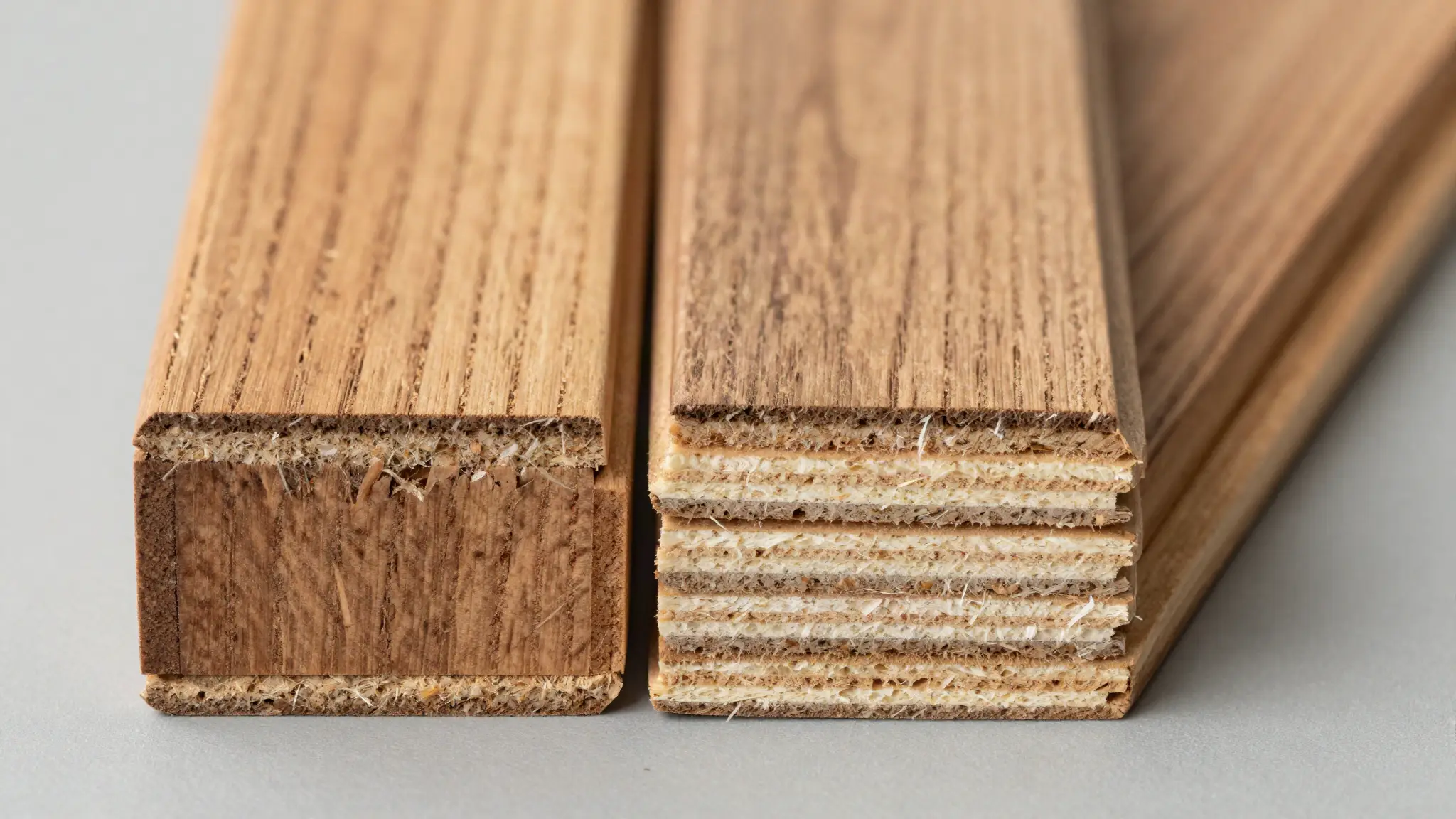
Solid hardwood is exactly what it sounds like: one piece of wood, top to bottom, typically ¾ inch thick. Engineered hardwood has a real hardwood wear layer — often thick enough to sand and refinish more than once — bonded over layers of plywood running in alternating grain directions, similar to how plywood itself is built. That plywood core is what gives engineered hardwood its biggest practical advantage.
Where engineered hardwood wins
Plywood is dimensionally more stable than solid wood, meaning it expands and contracts less with humidity swings. That makes engineered hardwood the right call over radiant heat, in basements, and in homes close to the water where humidity swings are more extreme than the national average — we cover that in more detail in our post on shore-area humidity. Engineered floors can also be installed directly over more subfloor types without the same acclimation window solid wood needs.
Where solid hardwood wins
Solid hardwood's advantage is longevity through refinishing. A quality solid floor can be sanded and refinished many times over 50-plus years, which is real long-term value for a forever home on a dry, above-grade level. Because there's no plywood core, there's also no limit on how thick the visible wear layer is — every refinish removes wood, but there's simply more of it to work with over the decades.
The "engineered is cheaper/worse" myth, debunked
Premium engineered hardwood with a thick wear layer often costs close to what mid-range solid hardwood costs, and it isn't a compromise product — some of the widest, most dramatic plank styles are only practical as engineered construction, because solid wood that wide would move too much with humidity to stay flat. The right question isn't which one is "better" in the abstract, it's which construction fits your specific room.
What each actually costs installed
Both constructions span a wide range depending on species and wear-layer thickness — installed hardwood in our market runs $6–$14 per square foot whether solid or engineered, with the specific number driven more by species, plank width, and finish than by construction type alone. See our full cost breakdown for what moves that number.
How we actually decide, room by room
On a typical whole-home quote, we'll often recommend solid hardwood for a dry, above-grade living room and engineered for a basement or a room over radiant heat in the same house — that's not indecision, it's matching the material to the conditions. See the full range of species and installation options on our hardwood flooring page, or get a free in-home recommendation for your specific rooms.