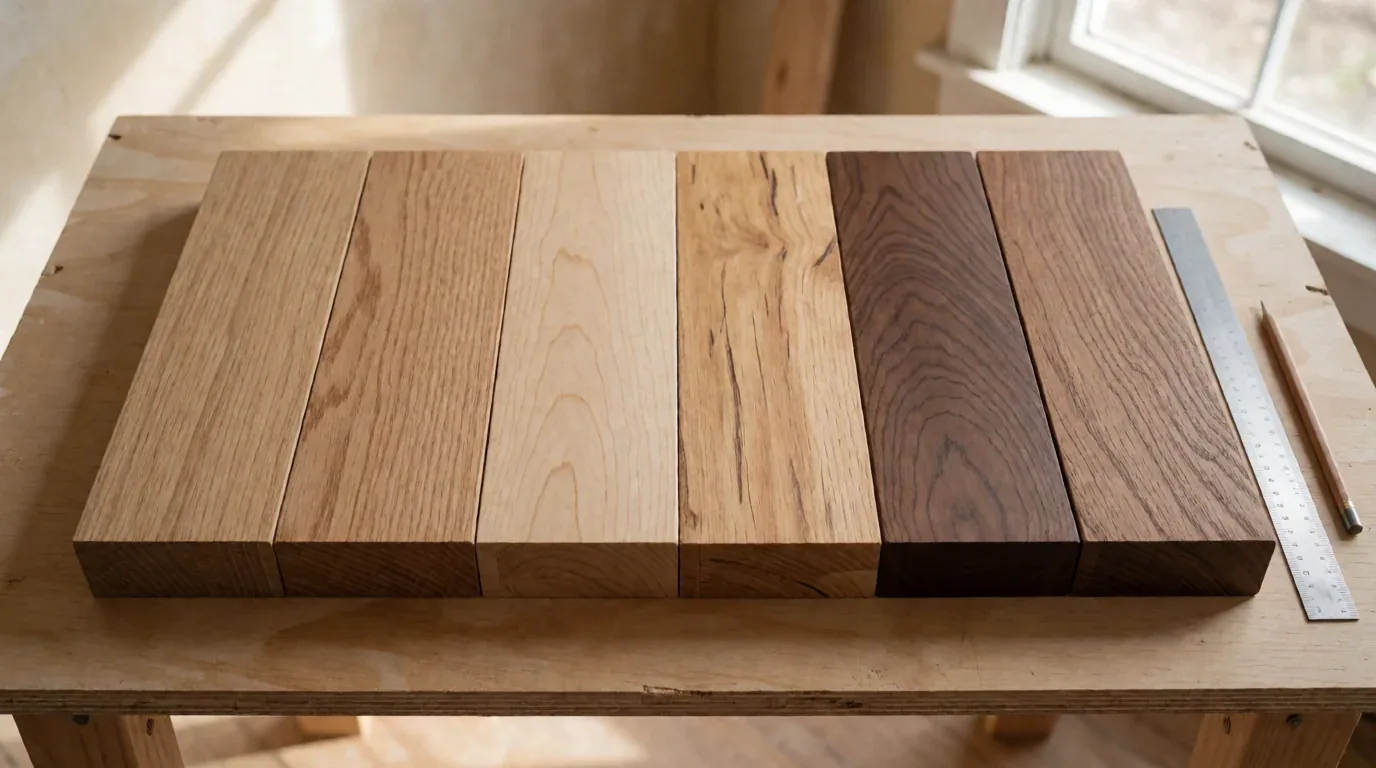
You are standing in a supplier showroom with six boards in your hand and someone asking which one you want. The honest answer is that no species is best on its own. Hardness and movement decide most of it, and the room decides the rest.
What a Janka number actually tells you
The USDA Forest Products Laboratory measures hardness by pushing a small ball into the wood and recording the load it takes to sink halfway in. That test is what the Janka rating comes from.
Here is what the Wood Handbook reports for side hardness at 12 percent moisture content: pecan, in the hickory and pecan group, at 1,820 lbf, sugar maple at 1,450, and white oak at 1,370.
Northern red oak comes in at 1,290, American beech at 1,300, black walnut at 1,010 and black cherry at 950. The imported table has harder entries still, with ipe, sold as Brazilian walnut, at 3,680 lbf.
Now here is the part people miss. Hardness is about dents, not scratches. No species is protected from a dog claw, a heel or a dropped screwdriver.
No Janka number changes that. Hardness tells you what happens when something heavy lands on the floor with force. It also says nothing about how the floor moves.
Those are two different properties, and the second one is what damages floors in New Jersey. Our guide to flooring for homes with dogs and cats covers the scratch side in more depth.
How much the wood moves is the number that matters here
The NWFA Installation Guidelines publish a chart of solid tangential shrinkage from green to oven-dry for dozens of species. Read it from the stable end.
Australian cypress sits at 2.8 percent. American chestnut is at 6.7, black cherry at 7.1, American black walnut at 7.8, northern red oak at 8.6 and white oak at 10.5.
At the other end, true hickory is at 12.6, American beech at 11.9 and hard maple at 9.9. The hickory and pecan group sits mid-chart at 8.9, right next to northern red oak.
That is the trade nobody tells you about. The NWFA makes the same point in its radiant heat guidance, naming American chestnut, black cherry and black walnut as the dimensionally stable species.
Hickory, beech and maple are listed there as less suitable over radiant heat. That answer applies to the rest of the house too.
For a Jersey Shore home, this is the part that decides the job. A house in Sea Girt or Manasquan swings harder through the summer than a house inland.
The board that moves the most is the board that cups, gaps and takes a beating at the edges. Our shore humidity guide covers that swing in detail.
Species by species, and where each one fits
White oak sits in the middle of the road on hardness at 1,370 lbf, hard enough for daily life and still steady enough for a normal house.
Red oak is a touch softer and a touch more stable than white oak, and which makes it a reasonable middle choice for most rooms.
If you want one species to cover the whole house without a fight, red oak is the one to start with.
Pecan is the hardest domestic wood in that table, at 1,820 lbf. Hickory is the most honest looking one of the set, with heavy contrast and dark flecks, and the NWFA lists it as photo-sensitive, so the color shifts with light and age.
True hickory sits at the far end of the stability chart, so it wants a stable construction and a dry house. People who like hickory are usually surprised by how much they end up liking it.
Hard maple is hard, light and quiet in color. The USDA calls it sugar maple, at 1,450 lbf, which puts it above both oaks on hardness.
The NWFA puts it in the less stable group, so it wants the same care as hickory around humidity.
Black walnut is the dark one, and one of the softer hardwoods on this list at 1,010 lbf. What it gives you is a deep, even color that changes a room.
American chestnut at 6.7 and black cherry at 7.1 are both more dimensionally stable than walnut on the NWFA chart. Walnut is a good fit for a formal room and a poor fit for a hallway with a dog.
American beech sits in the middle on hardness and near the bottom on stability. Those two numbers together make it the hardest sell of the domestic list in a shore house.
Black cherry is the softest of these at 950 lbf, but the NWFA lists it among the dimensionally stable species.
What about bamboo and Brazilian walnut
Bamboo is not a wood species, and calling it one is the first mistake people make. It is a grass. The NWFA lists three common styles, vertical, horizontal and strand woven.
Most bamboo flooring is strand woven, which means cut strands of bamboo are bonded with adhesive and then machined into a board.
That construction changes how it behaves. Australian installation standards note that bamboo floors move differently from solid timber and are not comparable to it on moisture content.
They also note strand woven bamboo is made at about 7 percent moisture content, against about 9 percent for engineered wood. Different product, different rulebook.
Brazilian walnut is not walnut either. It is ipe, a tropical hardwood the USDA lists at 3,680 lbf, harder than any domestic species in the same table.
It is also an imported species, and the NWFA says imported and tropical species often take two to three times longer to acclimate than most domestic species.
Species is the second decision, not the first
Before you pick a board, you pick the construction, because the construction decides how much the species matters. Solid wood can be sanded and refinished many times over its life. Engineered can sometimes, depending on how thick the wear layer is.
If you are in a rental, a first house or a room you might redo in a few years, that fact changes the species list more than any hardness number.
Our engineered versus solid guide goes through the build of each one and where each one wins.
And if you are adding floor next to an existing wood floor, the match has to happen at the species and the cut, not just the stain color.
Our guide to matching new hardwood to existing floors covers that.
One more thing belongs in the same conversation. Grade and species are different decisions. The grade decides how much color variation and how many knots you live with.
Grade is what you see on the face of the board: how much color variation and how many knots you live with. Our matching guide covers how a board is picked to sit next to what you already have.
How I narrow it down on a visit
The first thing I ask is who lives in the room and what walks across it. The second question is where the house sits relative to the water.
That decides how much movement the floor has to survive. The third is whether the floor will ever be refinished, which decides solid versus engineered.
Then I show you the samples next to each other in the light of the room, not under store light. Board color under store light and board color in a north-facing living room in Ocean County are two different colors.
That is usually the moment the decision actually gets made.
Honestly, the species is often the last thing that should decide the floor. The subfloor, the moisture in the house and the construction come first.
The species is what you get to enjoy on top of them. If you want a straight read on your house, send us the details and we will tell you what we find.
Call (732) 889-6029, email contact@jerseyconcept.com, or request a ballpark estimate and we will look at the room before anyone talks about a species.
Frequently Asked Questions
What is the best hardwood species for a New Jersey home?
It depends on the room more than the house. For heavy traffic and a family with dogs, a harder species such as hickory or hard maple holds up better. For a first floor close to the bay, stability matters more than hardness, and engineered construction usually wins. White oak and red oak sit in the middle on both counts, which is why they keep coming up. Our hardwood flooring page walks through how we pick for each space.
Which hardwood species is the hardest?
The USDA Forest Products Laboratory measures hardness with a Janka-style test. At 12 percent moisture content, pecan in the hickory group rates 1,820 lbf, sugar maple 1,450, white oak 1,370, Northern red oak 1,290 and black cherry 950. Hardness resists dents, not scratches, and it does not make a floor more dimensionally stable. A soft species in a quiet bedroom can be the better call.
Is bamboo a hardwood?
No. Bamboo is a grass, and the NWFA says so plainly. Most bamboo flooring is strand woven, which means cut bamboo strands are bonded with adhesive and machined into boards, so it behaves differently from a solid wood floor. Australian standards note bamboo moves differently than solid timber and is not comparable to it on moisture content. Judge it on its own data sheet, not on an oak number.
Do I need a different hardwood species for each room?
You can, and plenty of homes do it. The bedroom can carry a softer, warmer species while the living room takes a harder one. The rule that matters is that two solid wood rooms sitting next to each other read as one floor when the species and the stain match. Engineered gives you more freedom, since the wear layer is a different piece of wood than the core.
Sources & Further Reading
- USDA Forest Products Laboratory, Wood Handbook Chapter 4 (Green, Winandy and Kretschmann): Tables 4-3b and 4-5b, side hardness at 12 percent moisture content
- National Wood Flooring Association, Wood Flooring Installation Guidelines: solid tangential shrinkage chart, bamboo flooring and radiant heat guidance
- Australian Timber and Flooring Association, Specification for Engineered Bamboo and Laminate: bamboo construction and moisture content
- Ambient Bamboo, CSI-LEED Engineered Strand Bamboo: strand bamboo construction and installation